
Cultural Humility in Patient Care
By Dr. Kim Grahl
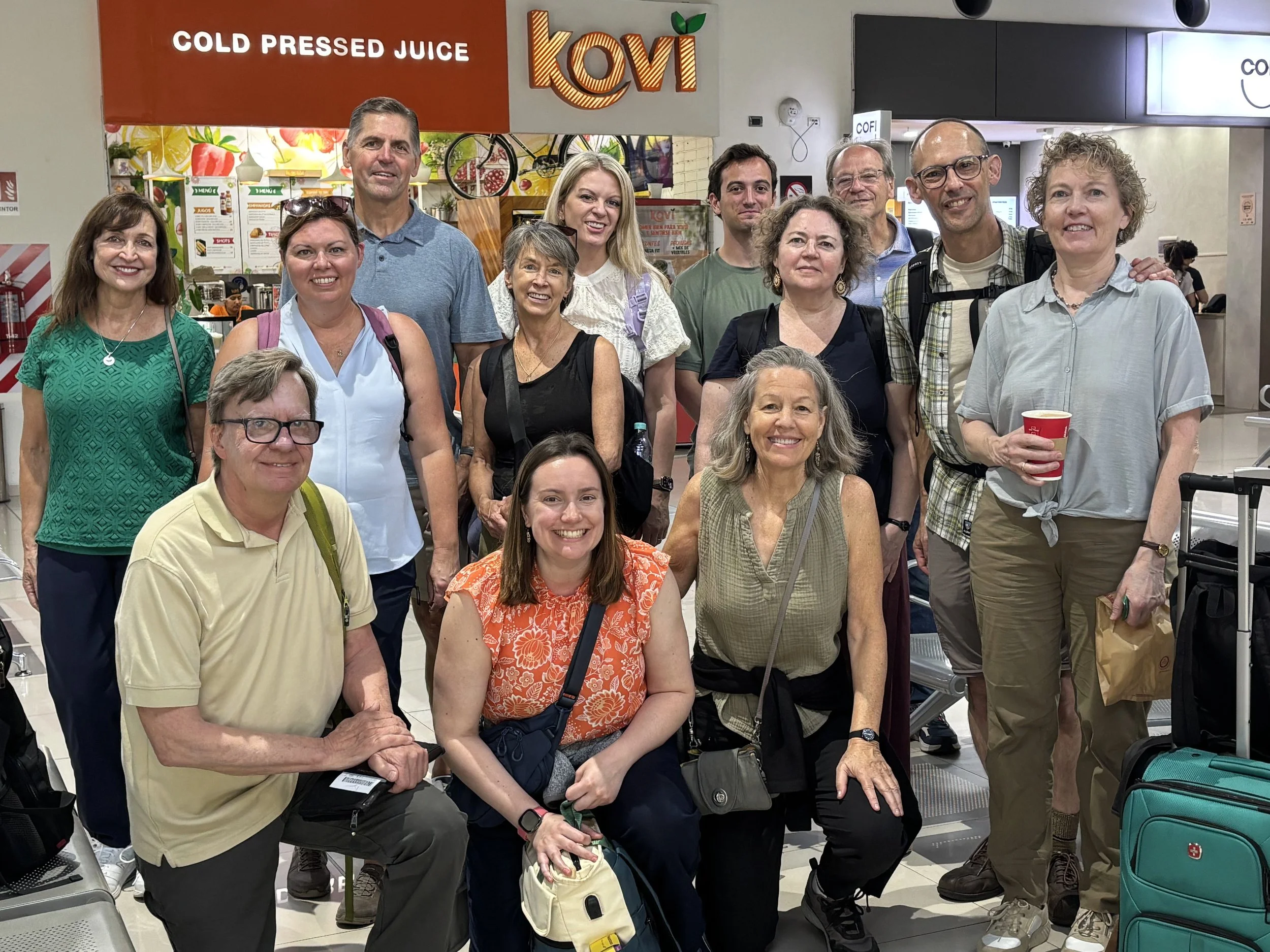
The Multi-Specialty Mission Trip (MSMT) team at the airport, before flying to Bolivia.
It is Saturday morning, and I am seated in an exit row, en route to Chicago via Panama City after spending a week in Cochabamba, Bolivia, as the internal medicine physician on Solidarity Bridge’s Multi-Specialty Mission Trip (MSMT). Buckled into their seats around me are nine other team members, which include a cardiologist, a gynecologic surgeon, a dermatologist, an emergency medicine physician, an operating room nurse, and others.
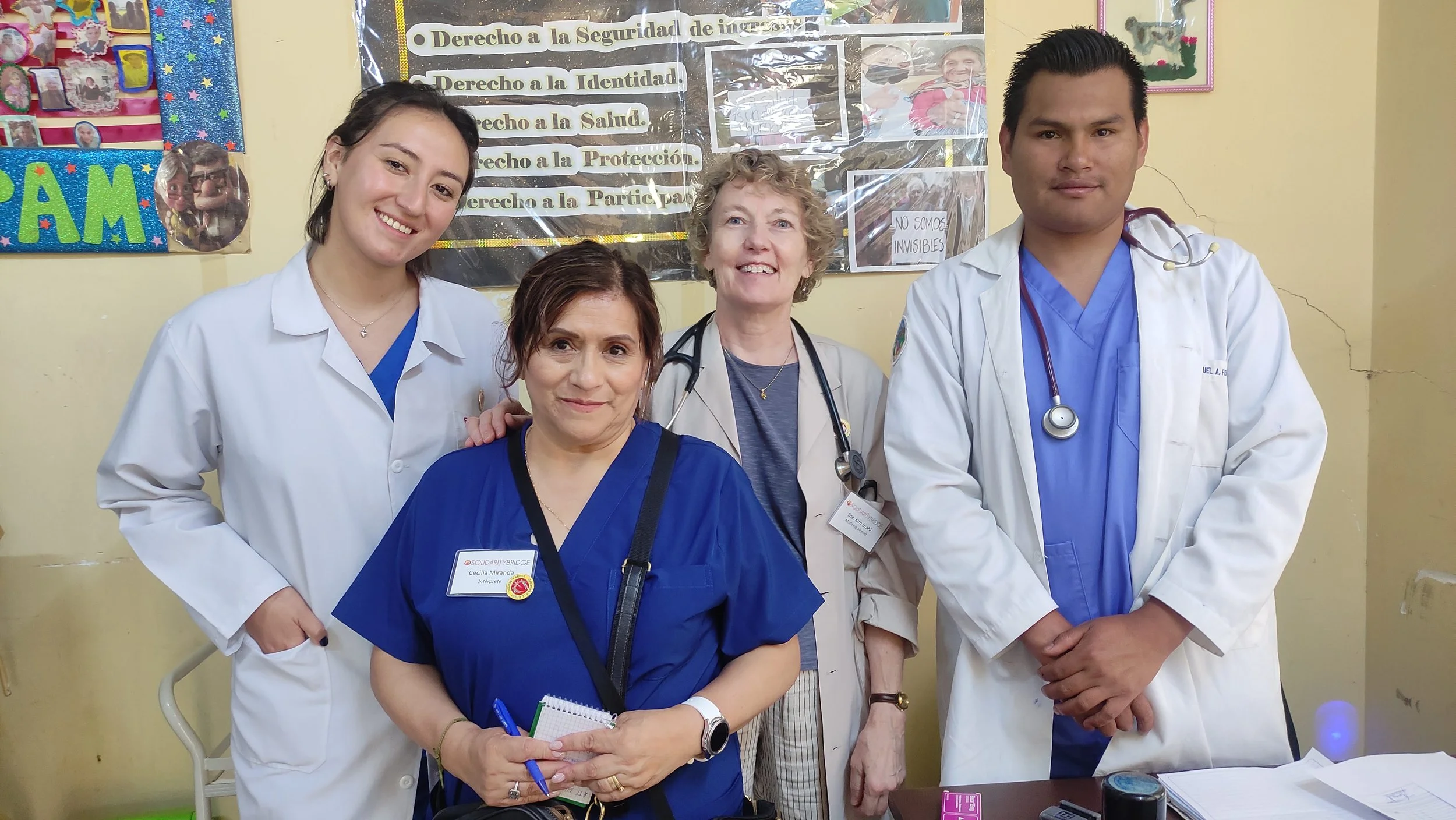
For the past week, I have had the honor of collaborating with Dr. Miguel Angel Fuentes, a Bolivian internist whose one-room clinic is situated a few blocks from Tiquipaya Hospital, where the rest of our MSMT team cared for patients this week. Dr. Fuentes’ clinic is tucked into a narrow space next to the Church of San Miguel, housed in a ‘centro de la tercera edad,’ which in the U.S. we might call a ‘senior center’.
I am forever trying to expand my Spanish vocabulary; my favorite new term from this trip is ‘la tercera edad’ which means the third era/age/stage of life (the first two being childhood and adulthood). I love that this term, unlike ‘senior citizen’ or ‘elderly,’ lacks condescension and reminds us that we will all one day get to that stage, if we are lucky.
Each morning, my translator Fernanda and I navigated our way along the rocky narrow sidewalk, admiring the glorious purple blooms of the jacaranda trees, and up the steps of the church; a ramp alongside the steps makes the clinic wheelchair accessible. If we arrived early enough, we would see Dr. Fuentes zoom up the ramp on his motorcycle, which he parked across from the long wooden bench, placed outside of the clinic, that served as the waiting room.
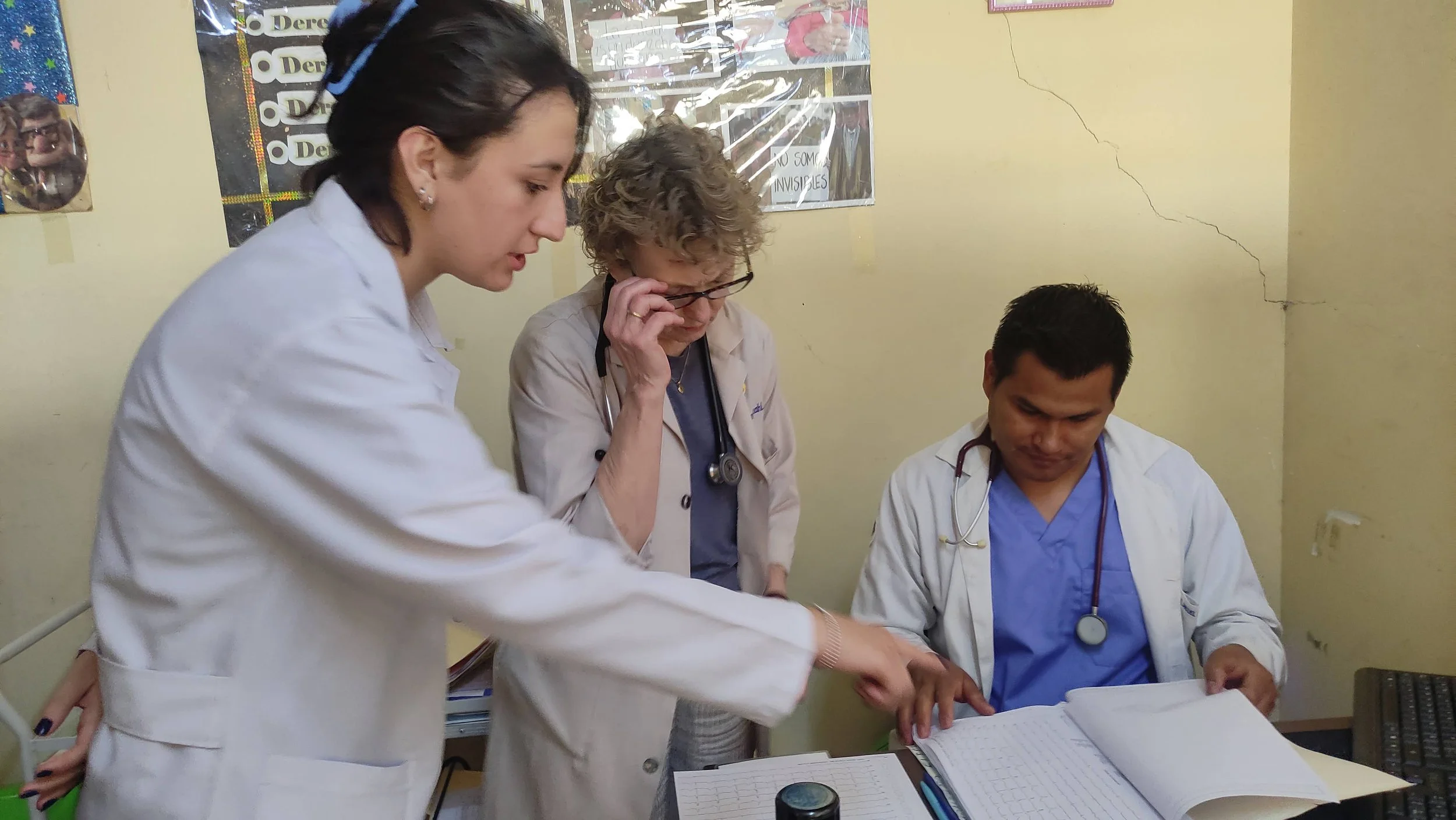
Dr. Grahl (in the middle) reviews patient cases with Dr. Fuentes (on the right).
Dr. Fuentes is an excellent, experienced internist and I found much to admire in his wise, compassionate approach to patient care; discussing his cases allowed us to exchange knowledge and perspectives on treatment options from the context of each of our countries. At the start of the week, I had trepidation about whether the knowledge and experience I have acquired after decades of working in a well-resourced health system, caring for a patient population from the suburbs north of Chicago, most of whom have Medicare or employer-sponsored private health insurance, would be at all relevant to the patients I would see in Bolivia.
As it turned out, in many ways, the patients who sought care at the clinic had many of the common medical problems as my patients back home. Of course, there are diseases seen in Bolivia that I almost never see in my practice—Chagas’ disease with all of its cardiac and gastrointestinal complications, chronic lung disease related to living at high altitude and/or cooking over open fires, parasitic infections—but for the most part, the maladies that Dr. Fuentes and I addressed in his aging patients were the same things I see in my patients in Evanston, Illinois.
Human bodies break down in much the same way as we age, whether you spend your life living in Chicago or Bolivia. Knees, hips, and hands become arthritic. The vertebrae and discs in the lower back degenerate and slip out of alignment, irritating the surrounding nerves. Varicose veins and heart failure cause swollen ankles. Diabetes, hypertension, and gastritis are common, as are depression, headaches, and sleep disturbances. The loss of a spouse—whether to abandonment, divorce, or death—can be devastating to one’s mental health and financial stability.
What is different is the cultural context.
When health care professionals in the U.S. talk about high quality medical care, we use terms like ‘evidence-based’, and ‘standard of care.’ We might think that our approaches are always the right ones. But that fails to take into account the cultural context.
Sometime around the year 2000, those of us who worked in big hospital systems were required to attend mandatory training in ‘cultural competence,’ the notion being that one could be trained to effectively communicate with and provide medical care to people from cultures different from our own. This concept evolved over the subsequent decades and we now focus on practicing ‘cultural humility,’ continually reminding ourselves that we have so much to learn about the specifics of an individual’s social context, and that this requires us not only to ask questions with an open mind, but most importantly, to cultivate an awareness of our own assumptions and cultural biases. During my week collaborating with Dr. Fuentes, I found myself reminded of this time and again.
One patient we saw during the week, whom I will call Mr. Q, had lost a lot of weight over the past 6 months. His pants were falling off of him; I saw that he had changed to a tighter hole in his belt buckle from the one he had obviously used in the past. I immediately wondered if he had cancer, and thought he needed an extensive panel of blood tests and CT scans. I wondered if it was pancreatic cancer, which had been the case with several patients of mine who had come in over the years with sudden dramatic weight loss.
But Dr. Fuentes was aware of Mr. Q’s social situation. He lived alone; his wife died a few years ago and his adult daughter has moved out and married.
“What have you been eating?” Dr. Fuentes asked, looking at his patient with an expression that said he would be neither surprised nor judgmental of the answer.
“Oats and milk,” Mr. Q said.
That is all he had been eating for months. No wonder he was wasting away.
Dr. Fuentes was direct with Mr Q; “You have to ask your daughter for help,” he told him.
I could not help smiling when Mr. Q, after taking this in, said to Dr. Fuentes, “I think you are a wizard. You hit the nail on the head.”
As I once heard Dr. Paul Farmer say, “the solution to hunger is food.” And the solution to this man’s weight loss was to ask for help. He just needed his trusted doctor to help him realize this.
The encounter unsettled me, not only because of Mr. Q’s isolation and malnutrition, but because I couldn’t let go of my impulse to want to send him for a CT scan. In discussion with Dr. Fuentes and others this week, I began to understand why the threshold for ordering a CT scan in a patient is far, far higher than it is in the United States. Consider this: in the city of Cochabamba, population 670,000, there exists only one CT scanner in any public hospital, and that CT scanner—the only one that would have been available to this patient—has not been working since at least July.
Still, I worried—what if Mr. Q did have cancer lurking in his belly? What if we didn’t find it now? We could be accused of causing a delay in diagnosis; we U.S. doctors live in fear of that. And here is where cultural humility really starts to get interesting. That ever-present fear of being accused of missing something drives so much of the over-testing and over-imaging that is skyrocketing the cost of health care in the U.S.
There are also potential harms to consider. CT scans can provide critical diagnostic information, but they expose patients to ionizing radiation, which can increase the risk of developing cancer over a lifetime. A study published in JAMA in April 2025 used mathematical risk modeling to estimate that CT scans performed in the United States in 2023 could eventually result in more than 100,000 additional cancer cases. These are modeled projections, not cancers that have been directly observed or definitively attributed to individual scans, and the risk varies depending on many factors. Still, the findings raise important questions about how often we order CT scans and whether the expected diagnostic benefit justifies the potential risks.
In Bolivia, limited access to diagnostic tools can mean that cancers and other serious conditions are detected at later stages. In the United States, meanwhile, we have much greater access to imaging, but that access comes with its own challenges, including unnecessary testing, higher costs, and the cumulative risks of radiation exposure. It would be an overstatement to say that we are simply causing cancers with the CT scans we order; many scans are essential and can be lifesaving. But we must also recognize that more testing does not always mean better care.
That should give a person a dose of humility. Cochabamba certainly needs the spare part for that CT scanner to show up sometime soon. But applying my cultural bias about who should and shouldn’t get a CT scan, without considering the realities and clinical judgment that shape care in another setting, simply is not helpful.
Meanwhile, the week is over, and the MSMT team is headed home. As our plane takes off, I look out of the window and watch the ever changing landscape of Bolivia—now mountains, now fields, now forest; the country is all of that and more. I think of Mr. Q and hope that someone is cooking up a nourishing dinner for him at this very moment. I am grateful to him and to everyone I have met and worked with this week; as we ascend up over the clouds, I settle into my seat with a lot to think about.
